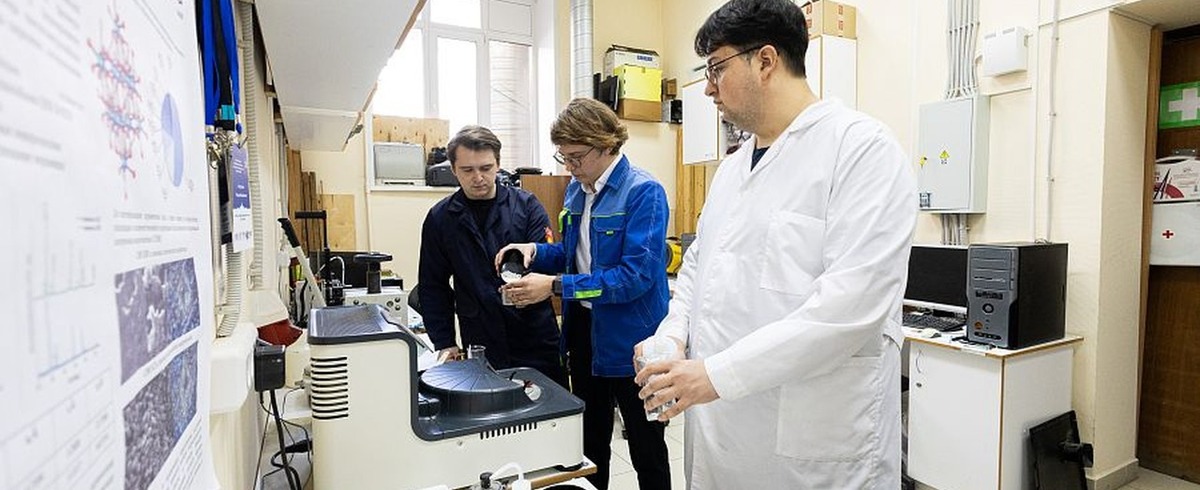

Scientists at the Ural Federal University (UrFU), in collaboration with researchers from the Institute of Solid State Chemistry of the Russian Academy of Sciences, have developed six high-entropy ceramic formulations capable of withstanding temperatures of up to 2,100°C and high levels of radiation. The material could be used in the production of thermal protection coatings for aerospace equipment and other applications subject to extreme conditions.
The new ceramic belongs to a class of materials known as high-entropy oxides, composed of five or more components that form a single solid solution and share the same crystal structure. According to the researchers, the ability to vary the components allows the thermal and electrical properties of the material to be adjusted according to the intended application.
“We work with high-entropy materials, a new class of complex oxides made up of five or more components. These materials are not composites, but rather a single solid solution of five or more components that form a common crystal lattice. By varying these components, we can influence the properties of the ceramics,” said Roman Bastrikov, an engineer in the Department of Rare Metals and Nanomaterials at UrFU and one of the study’s authors.
During testing, the researchers found that the different formulations exhibited high resistance to extreme temperatures and radiation. Some samples remained virtually unchanged after exposure to irradiation, while conventional reference materials underwent structural changes.
“All samples show high radiation resistance and some formulations were not affected by irradiation. Stabilised zirconium oxide, for example, undergoes structural changes when exposed to the same radiation doses,” Bastrikov said.
Another factor considered by the researchers is the low thermal conductivity of the new ceramic, which is lower than that of stabilised zirconium oxide. This characteristic could help reduce heat transfer and, consequently, material degradation when subjected to high temperatures.
The material also exhibits a thermal expansion coefficient similar to that of certain metals. This property can reduce stresses and deformations when the ceramic is applied over a metal substrate subject to temperature variations, potentially increasing the durability of components.
Beyond the aerospace industry, the researchers point to possible applications in solid oxide fuel cells, where the material can function as an electrolyte, as well as in substrates and insulators for embedded electronic systems. The ceramics could also be used in structural components intended for hypersonic applications, including aircraft and spacecraft subject to extreme temperatures and environmental conditions.

According to the team, the different formulations allow the material to be selected based on the combination of properties required for each application. The researchers intend to continue developing the technology and to establish collaborations with industrial partners to evaluate possible commercial applications.
Source: Diário Económico
Original article: https://www.diarioeconomico.co.mz/?p=548242