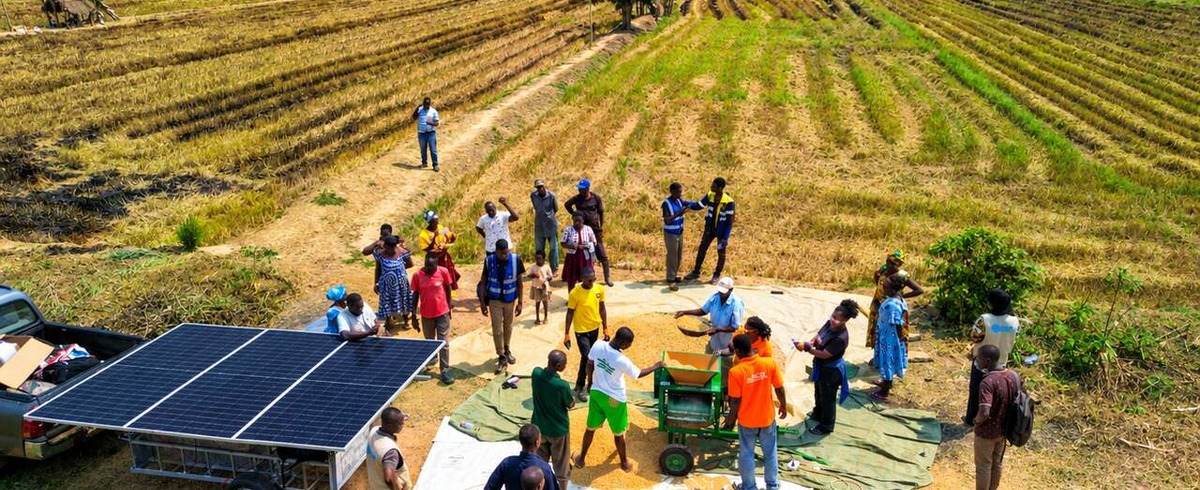

Wobil Technologies, a Ghanaian startup founded by students Erica Appiah and John Wobil at the Kwame Nkrumah University of Science and Technology, has developed a range of hybrid solar-powered agricultural machines designed to support smallholder rice farmers and reduce losses incurred during post-harvest processing.
According to the founders, the idea emerged after they built a small wooden, petrol-powered device that took them to a farm in Adansi Asarekrom for a demonstration. The reaction from farmers — who expressed genuine interest in using and paying for the equipment — prompted the team to develop the project further.
Research conducted in 2021 confirmed the scale of the problem. According to the startup, farmers in Ghana and other parts of Africa were losing up to 46% of their production through manual threshing, which was frequently carried out with delays and compounded by grain quality issues.
Drawing on the needs identified among producers, the team initially developed a diesel-powered metal thresher. Wobil Technologies subsequently pivoted towards renewable energy, producing its flagship solution: a hybrid solar-powered rice thresher, for which a patent application is pending. The startup has also developed a solar-powered machine for grain cleaning and separation.
According to co-founder Erica Appiah, the technologies were designed specifically for African farming conditions and can reduce post-harvest losses, improve grain quality, and cut energy costs by more than 70% compared with conventional diesel-powered threshers.
Since 2021, the startup says it has served approximately 900 smallholder farmers, processed one thousand tonnes of rice, and helped generate 4.7 million Ghanaian cedis — equivalent to roughly US$420,000 — in additional revenues for farmers.
The solution also addresses the economic constraints facing smallholder producers. Imported threshers can cost as much as US$10,000, a prohibitive sum for many farmers. To improve access, Wobil offers pay-per-use and leasing payment models, alongside a community-based service and maintenance network.
Beyond its impact on farm revenues, the company has created 58 direct jobs. Currently, 36% of paying customers are women, and the startup has set a target of raising that share to 50% by 2028.
Wobil’s grain cleaning and separation machine has also been evaluated by the Council for Scientific and Industrial Research-Crops Research Institute (CSIR-CRI), an affiliate of Ghana’s Ministry of Food and Agriculture, which confirmed a cleaning efficiency rating of 98%.
Despite its expanding operations, Wobil Technologies has not yet drawn on venture capital. Funding has been secured primarily through grants, most notably the Women in Tech Accelerator — supported by the Standard Chartered Foundation and implemented in Ghana by the Ghana Climate Innovation Center with backing from Village Capital.

Wobil Technologies currently operates in the Ashanti and Volta regions and plans to extend its footprint to the Bono, Northern, and Western regions before entering other West African markets, beginning with Côte d’Ivoire and Nigeria.
Beyond its technological offering, the company is actively working to increase female participation in engineering and agri-tech. Co-founder Erica Appiah says that building a company in this sector as a woman has been challenging, but argues that the uptake of its machines by farmers and the recognition of her work demonstrate that more women can participate in creating and leading technology-driven solutions for agriculture.
Source: Diário Económico
Original article: https://www.diarioeconomico.co.mz/?p=539468