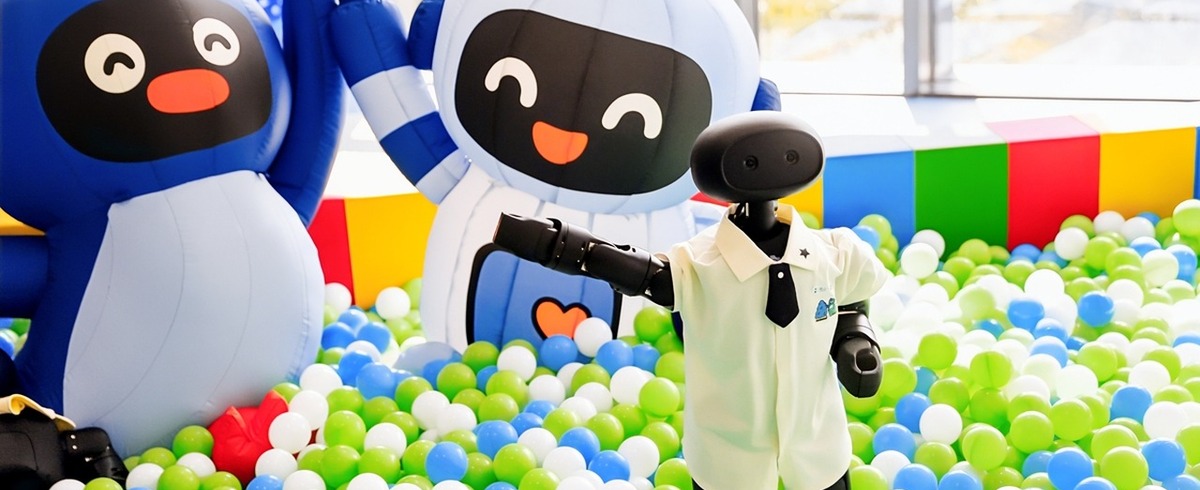

China has unveiled a ‘kindergarten’ for robots in Beijing — a facility designed to develop a new form of machine learning in which robots acquire skills through touch, trial and error, and direct physical experience, without relying exclusively on human demonstration.
The facility was established jointly by Tashan Technology, a Chinese company specialising in tactile sensors, and a team led by Richard Sutton, Turing Award laureate and a pioneer in reinforcement learning. Located in the Shijingshan district, the space is intended to provide a controlled environment where robots can interact physically with the world and learn from the consequences of their own actions.
During a demonstration observed by Global Times, robots repeatedly performed specific movements, received feedback through physical interaction, and adjusted their behaviour accordingly. When a robot collides with a wall while learning to walk, for instance, the impact is recorded as part of the experience. The machine then tries again, modifying its movements to avoid repeating the error.
The objective is to create a safe environment in which robots can learn how their own bodies function and develop the capacity to interact with the physical world. This process requires not only new algorithms, but also robots and environments specifically designed to facilitate experiential learning.
The initiative comes as China has been expanding its infrastructure for training humanoid robots. At present, many such systems are trained through human demonstration, teleoperation, motion capture, or simulated environments. While these methods enable the development of a wide range of behaviours, learning through direct interaction with the physical world remains a significant challenge.
The ‘kindergarten’ concept offers a different approach: allowing robots to continue learning even after they have been deployed. In this way, they could adapt to objects, environments, and situations that were not anticipated during initial training.
Despite its potential, autonomous learning still has limitations. The process can be slower than imitation-based learning and requires hardware robust enough to withstand the errors and collisions that are inherent to the experience. One researcher cited by Global Times summarised the challenge plainly: if a robot cannot make mistakes, it cannot learn.
Researchers believe, however, that experience accumulated by individual robots could in future be shared across machines, allowing what one learns to be used by others. This process could create a continuous cycle of exploration, data collection, learning, and refinement.
The technology remains at an early stage. In one test conducted at the facility, a small spider-like robot learned to move forward in approximately 40 minutes, with no prior knowledge. More complex tasks — particularly those involving humanoid robots — require the simultaneous management of factors such as balance, energy consumption, and environmental adaptation.

For now, autonomous learning is expected to complement existing methods such as teleoperation, imitation learning, and simulation. As robots move into factories, commercial services, and eventually homes, the ability to learn continuously from interaction with the environment may become one of the central frontiers of robotics development.
Source: Diário Económico
Original article: https://www.diarioeconomico.co.mz/?p=537899