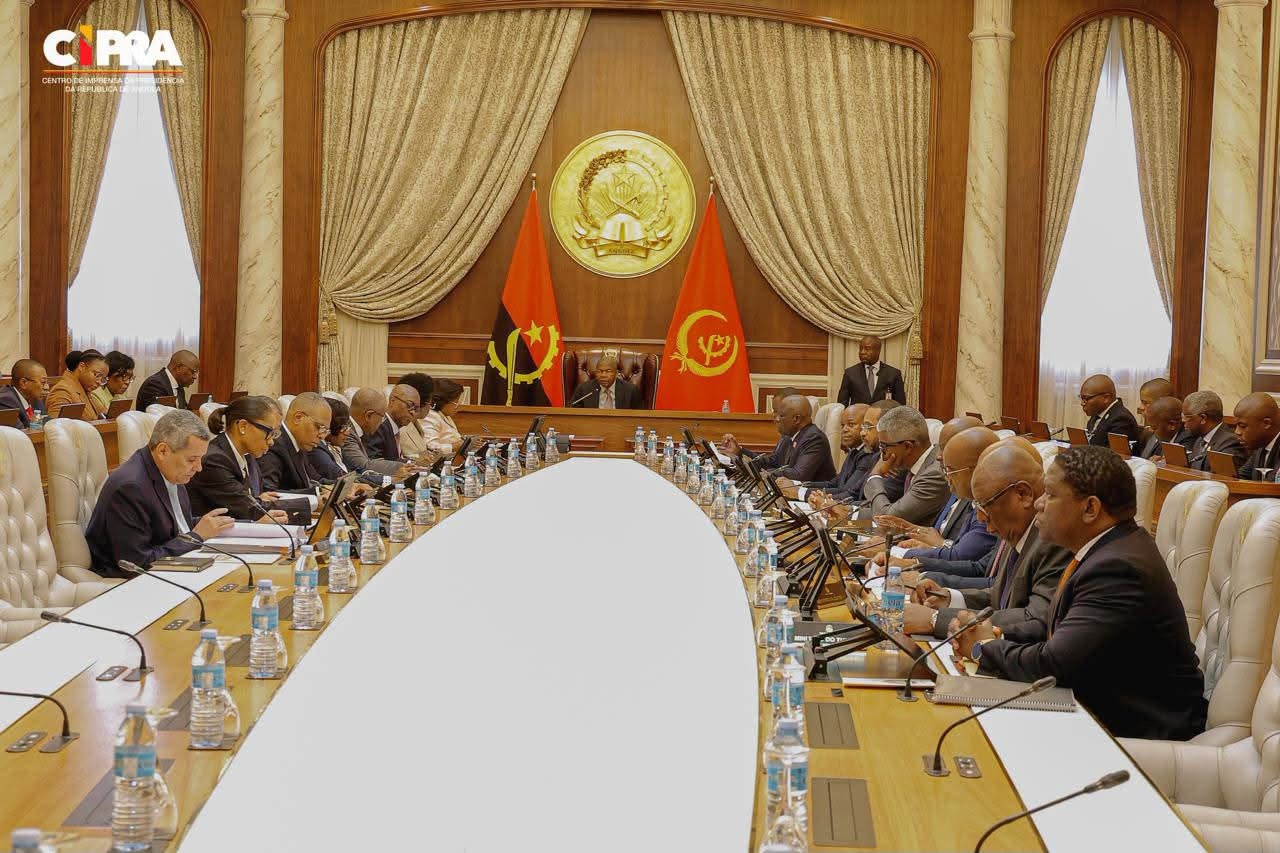

Angola’s public debt stock stood at 62.18 trillion kwanzas at the close of the 2025 financial year, the government confirmed following the eighth ordinary session of the Council of Ministers, chaired by President João Lourenço at the Presidential Palace in Luanda’s Cidade Alta.
The figure was disclosed in the official communiqué issued after the session, which reviewed the 2025 General State Accounts (Conta Geral do Estado, CGE) — the government’s primary instrument of fiscal accountability — before forwarding the document to the National Assembly for parliamentary scrutiny in compliance with constitutional and legal requirements.
According to the document examined by the council, total public revenue collected in 2025 reached 34.60 trillion kwanzas, against actual expenditure of 34.57 trillion kwanzas — a near-balanced outturn that kept the budget deficit in check.
The CGE consolidates the full financial and budgetary execution of the state. Its approval by the Council of Ministers triggers the formal transmission to the National Assembly, where lawmakers will conduct oversight of the government’s fiscal management over the year.
The accounts reflect the behaviour of Angola’s key public finance aggregates during a period of fiscal restraint and consolidation. By keeping expenditure closely aligned with revenues collected, the government was able to contain the budget shortfall and sustain the continuity of National Treasury commitments.
Beyond the accounts review, the eighth ordinary session also examined a range of instruments designed to stimulate broader economic activity.
In the minerals, oil and gas domain, the council reviewed legislative instruments related to concession area contracts for Blocks KON 2, KON 16 and 17/06, with the stated aim of encouraging private investment and securing the long-term sustainability of oil production.
The government reiterated its commitment to pressing ahead with measures to reduce the state’s equity stakes in public assets, with the objective of drawing in greater private-sector participation and reinforcing the sustainable balance of public finances.
The session was part of the regular schedule of ministerial council meetings that serve as the principal advisory body to the Head of State, bringing together cabinet members to deliberate on legislative proposals, policy instruments and the government’s budgetary performance.
Angola’s fiscal consolidation drive, anchored by an extended IMF programme, has sought to reduce dependence on oil revenues and broaden the tax base — a challenge underscored by the near-parity between 2025 revenues and expenditures recorded in the approved accounts.
Source: Mercado / Original article: https://mercado.co.ao/stock-da-divida-publica-de-angola-atinge-6218-mil-milhoes-de-kwanzas/