
Angola’s Ministry of Higher Education, Science, Technology and Innovation (MESCTI) has allocated $38.7 million to 13 public higher-education institutions through Results-Based Agreements (RBAs) to accelerate the expansion of Science, Technology, Engineering, Arts and Mathematics (STEAM) programmes — disciplines the government considers essential to national economic development.
The funding was awarded through two separate competitive rounds open to public institutions. The first round selected the Instituto Superior Politécnico do Bengo (ISP-Bengo), the Instituto Superior de Ciências da Educação de Benguela (ISCED Benguela), the Instituto Superior Politécnico do Cuanza Sul (ISPCS), the Universidade do Namibe (UNINBE), the Universidade José Eduardo dos Santos (UJES) and the Universidade Rainha Njinga Mbandi (UNRM).
Each of the six institutions selected in the first round received $3.05 million, bringing the combined allocation to $18.3 million. The second round qualified the Instituto Superior Politécnico do Bié (ISP-Bié), the Instituto Superior Politécnico do Soyo (ISP-Soyo), the Instituto Superior de Ciências da Educação da Huíla (ISCED-Huíla), the Escola Superior Pedagógica do Cuanza Norte (ESPECN), the Universidade Mandume Ya Ndemufayo (UMN), the Universidade Katyavala Bwila (UKB) and the Universidade Agostinho Neto (UAN). Each of these seven institutions received $3 million, for a second-round total of $20.5 million.
The grants form part of the Higher Education, Science and Technology Development Project (TEST), a government initiative co-financed by the World Bank with $150 million and by the Global Partnership for Education with $50 million.
The programme aims to raise teaching quality, improve equity of access, align curricula more closely with labour-market and economic needs, and strengthen governance across the higher-education sector. Of the $38.7 million committed to the 13 institutions, $710,000 has already been disbursed, according to TEST project data.
A deeper structural challenge underlies the initiative: over the decade to 2023, only one in ten graduates from Angola’s public higher-education system completed a degree in an engineering-related field, according to Expansão calculations based on MESCTI statistical yearbooks covering the 2014–2024 period. Analysts say the mismatch between the skills produced by universities and the economy’s actual requirements is a significant drag on the country’s long-sought economic diversification.
Over that ten-year period, a total of 218,544 students graduated from Angolan universities. Of that cohort, just 10% — or 19,907 graduates — obtained qualifications in Engineering and Technology, Manufacturing and Production, or Information and Communications Technology (ICT). Only 1% — 1,476 graduates — completed degrees in Agricultural Sciences and Fisheries, two fields the government regards as central to economic transformation.
By contrast, Social Sciences dominated academic output, accounting for 40% of all graduates — 82,289 individuals. Education Sciences followed with 29% (60,808 graduates), and Medical and Health Sciences represented 15% (30,822). All other disciplines combined accounted for the remaining 5% (9,958 graduates).
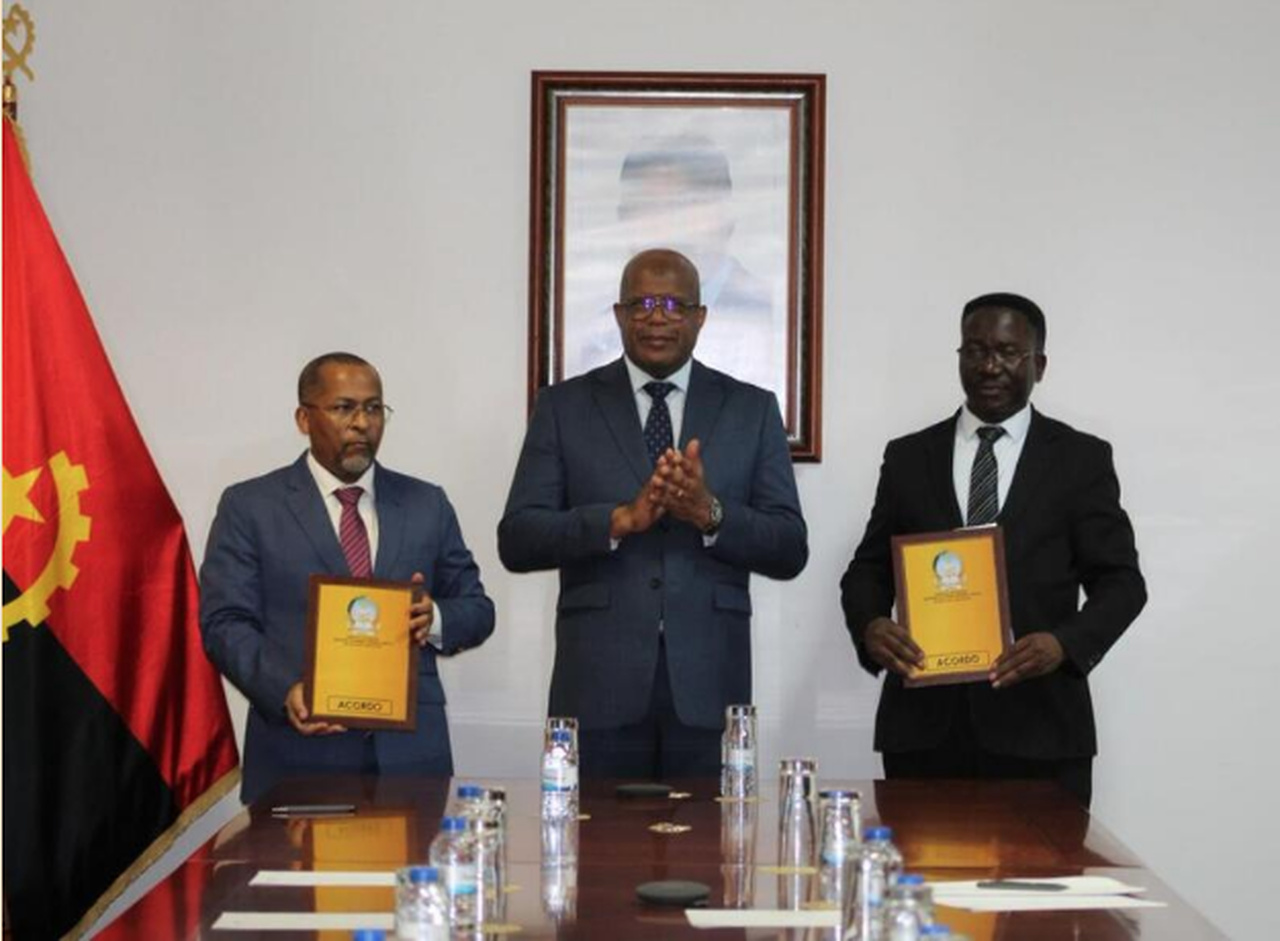
Results-Based Agreements are a financing mechanism adopted by MESCTI through the TEST project specifically to drive reform within public higher-education institutions. Unlike conventional block-grant funding models, RBAs disburse resources against pre-agreed performance targets and measurable indicators, with releases contingent on verified outcomes by all parties involved.
The TEST project represents one of the Angolan government’s most structured efforts to reshape the country’s higher-education landscape, using performance-linked financing to steer institutions toward disciplines with stronger links to private-sector demand and long-term economic growth.

Angola’s heavy dependence on oil revenues — which still account for the bulk of government income and export earnings — has long been cited as a driver of the skills imbalance, with generations of students gravitating toward social sciences and education in the absence of strong industry demand signals. The $38.7 million STEAM allocation is intended to begin reversing that trend through targeted institutional incentives.
Source: Expansão / Original article: http://expansao.co.ao/universidade/detalhe/387-milhoes-usd-para-financiar-cursos-alinhados-a-economia-75050.html