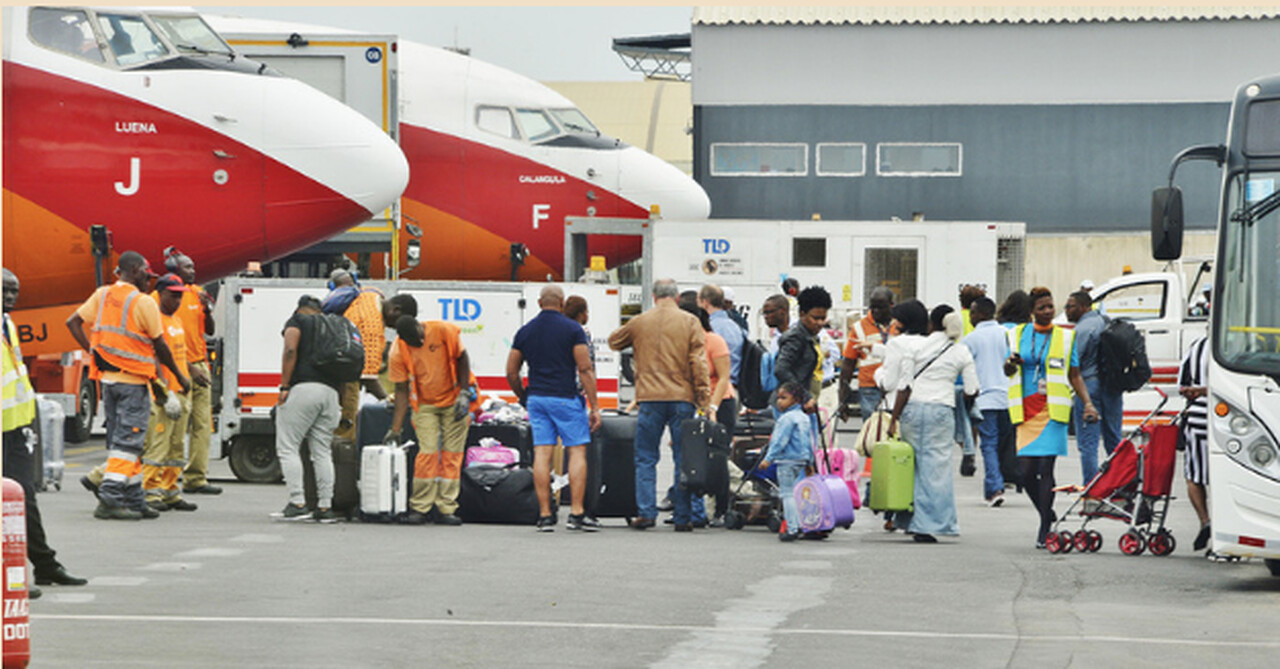

Angola’s national carrier TAAG transported approximately 744,000 passengers between January and July 2026, down roughly 59,000 — or 7.3% — from the estimated 803,000 carried over the same period in 2025, despite expanding its route network, adding frequencies and taking on new aircraft.
The figures were calculated by Expansão on the basis of monthly bulletins published by Angola’s National Civil Aviation Authority (ANAC) and the market-share data attributed to the carrier. Expansão requested official passenger numbers, load-factor data and operational clarifications directly from TAAG’s management, but received no response before the edition went to press.
The data reveal two diverging realities within the same airline. On domestic routes, TAAG’s passenger numbers fell from approximately 355,000 in the first seven months of 2025 to around 275,000 in the equivalent period this year — a loss of nearly 80,000 passengers, equivalent to a 22.4% decline. The domestic market as a whole also contracted sharply, shrinking from roughly 440,000 to 346,000 passengers, a fall of 21.4%. With a market share of around 80%, TAAG is effectively the engine of Angola’s domestic aviation sector, meaning its fortunes are closely tied to broader demand trends.
The international picture is more encouraging, though it too raises questions. TAAG grew its international scheduled passenger numbers from approximately 448,000 to 469,000 over the period — an increase of around 20,000 passengers, or 4.6% growth. The overall international scheduled market expanded more modestly, rising from 843,500 to 864,600 passengers, a gain of 2.5%. TAAG therefore grew at a rate nearly double that of the wider market in the first seven months of the year.
Compared with July 2025, TAAG had by the close of the period added three new international destinations. Nairobi launched in September of last year, Abidjan in April 2026 and Guangzhou in June 2026. Those three new routes alone initially added seven weekly frequencies — three to Nairobi, three to Abidjan and one to Guangzhou. The carrier also increased capacity on existing routes: Johannesburg went from nine to 11 weekly frequencies and Cape Town from ten to 11, while Maputo maintained five.
The operational expansion underscores the mismatch at the heart of TAAG’s current performance: a significantly broadened international offering is generating growth in absolute passenger terms, but the volume gains are insufficient to offset a steep collapse in domestic traffic, leaving the airline with fewer overall passengers than a year ago despite a materially larger network.

Source: Expansão / Original article: http://expansao.co.ao/empresas/detalhe/taag-abre-rotas-e-reforca-oferta-mas-perde-59-mil-passageiros-75060.html